
Why Some Bespoke Designs Begin with a Prototype?
At the moment, I am working on three prototypes for the same bespoke commission.
Although they all belong to the same project, each of them is at a completely different stage. One is almost ready to be sent to my client, another needs a small adjustment before I am happy with it, while the third has already required several rounds of reconstruction before I feel it is ready for its first fitting.
This is one of the things I enjoy most about bespoke work. Even when several pieces are created for the same person, they rarely evolve in exactly the same way. Every design follows its own path because each one presents different challenges. There is never a fixed formula to follow. Instead, the process develops according to what each creation needs in order to become the piece I originally imagined.
The camisole has developed almost exactly as I had hoped. After one last fitting on my side, I expect only very minor adjustments before sending it to my client. The shorts are also progressing well, but I have already identified a small correction that I want to make before they leave my atelier. I prefer presenting a prototype that already reflects the direction I believe the design should take, rather than asking my client to imagine how it might look after alterations.
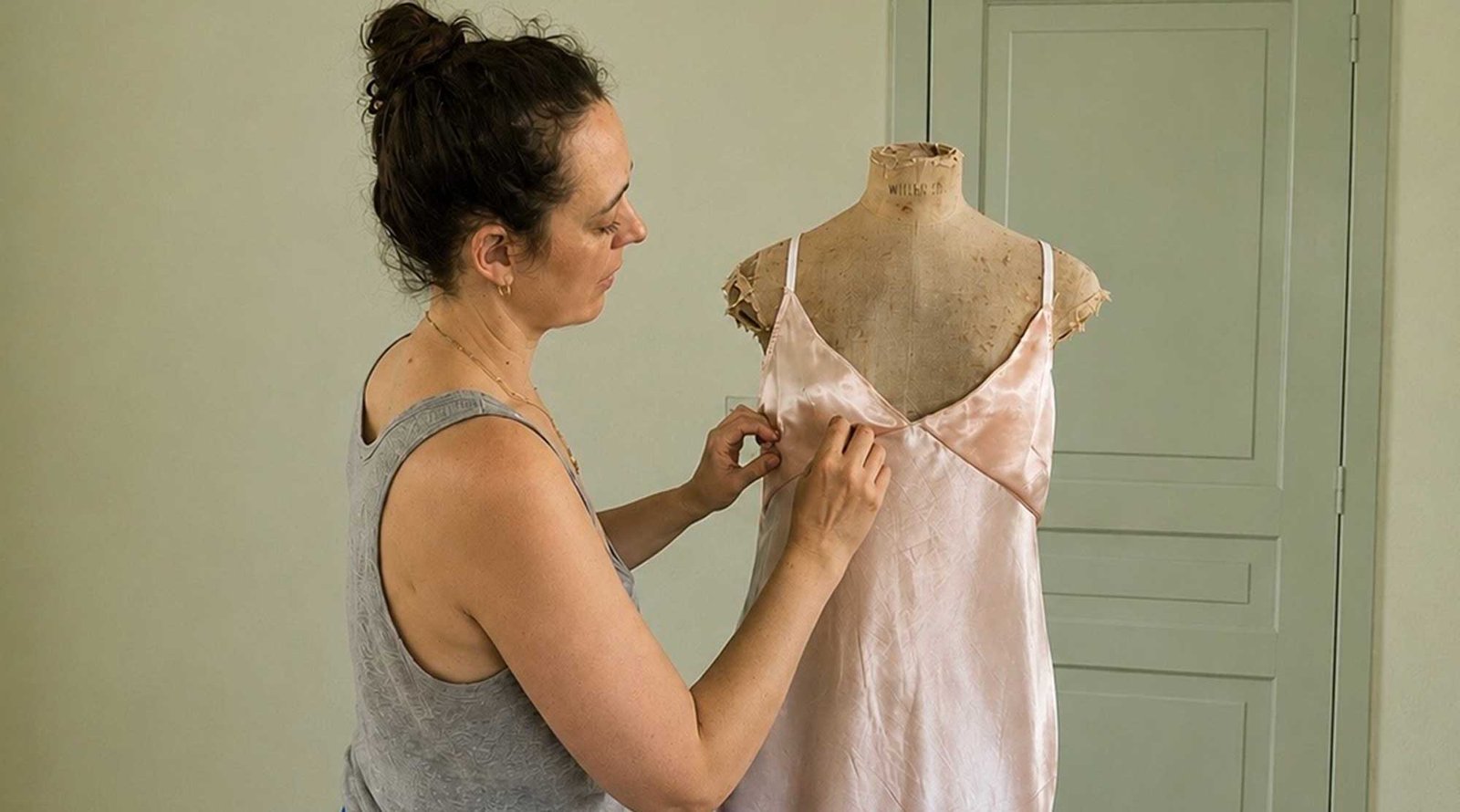
The nightgown, however, has followed a very different journey. As soon as I placed it on the mannequin, I realised that several elements still needed to evolve before it was ready for its first fitting. The neckline, the bust and even the overall proportions all required further development before I felt the design was expressing the original idea I had sketched. Some of those changes were small, while others required me to dismantle and reconstruct entire sections before continuing.
Watching these three pieces develop side by side is a reminder that creating a bespoke garment is never about following a predetermined sequence of steps. It is a process of observation, decisions and refinement, where each stage naturally leads to the next. Some questions are answered very quickly, while others only become visible once the design exists beyond paper.
One of the questions I am asked surprisingly often is whether I always make a prototype before cutting into silk.
The answer is more nuanced than many people expect.
This particular commission includes three completely different garments, each presenting its own challenges. Some of those questions can be answered while sketching, others while developing the pattern. But there comes a point where ideas on paper need to be confronted with a three-dimensional piece. Only then can I truly observe how the design behaves on a body, how the proportions relate to one another and whether the original idea has translated successfully from paper into reality.
That is why every garment in this commission begins with a prototype.
Why This Project Needed Prototypes
At first glance, it might seem logical that every bespoke garment begins with a prototype. In reality, that isn’t always the case. Whether I create one or not depends entirely on the questions that still need answering before the garment is made in its final fabric.
If I am adapting one of my existing designs, changing the colour of the silk, selecting a different French lace or making a relatively small alteration to a pattern I already know well, I often don’t need to begin again with a completely new prototype. Years of developing my own patterns mean that I already understand how those designs behave. I know how they fit, how the fabric moves and where adjustments are likely to be needed. Those commissions are still bespoke, but they build upon an existing foundation rather than starting from a completely new idea.
This project was different from the beginning because every piece involved a question that couldn’t be answered on paper alone.
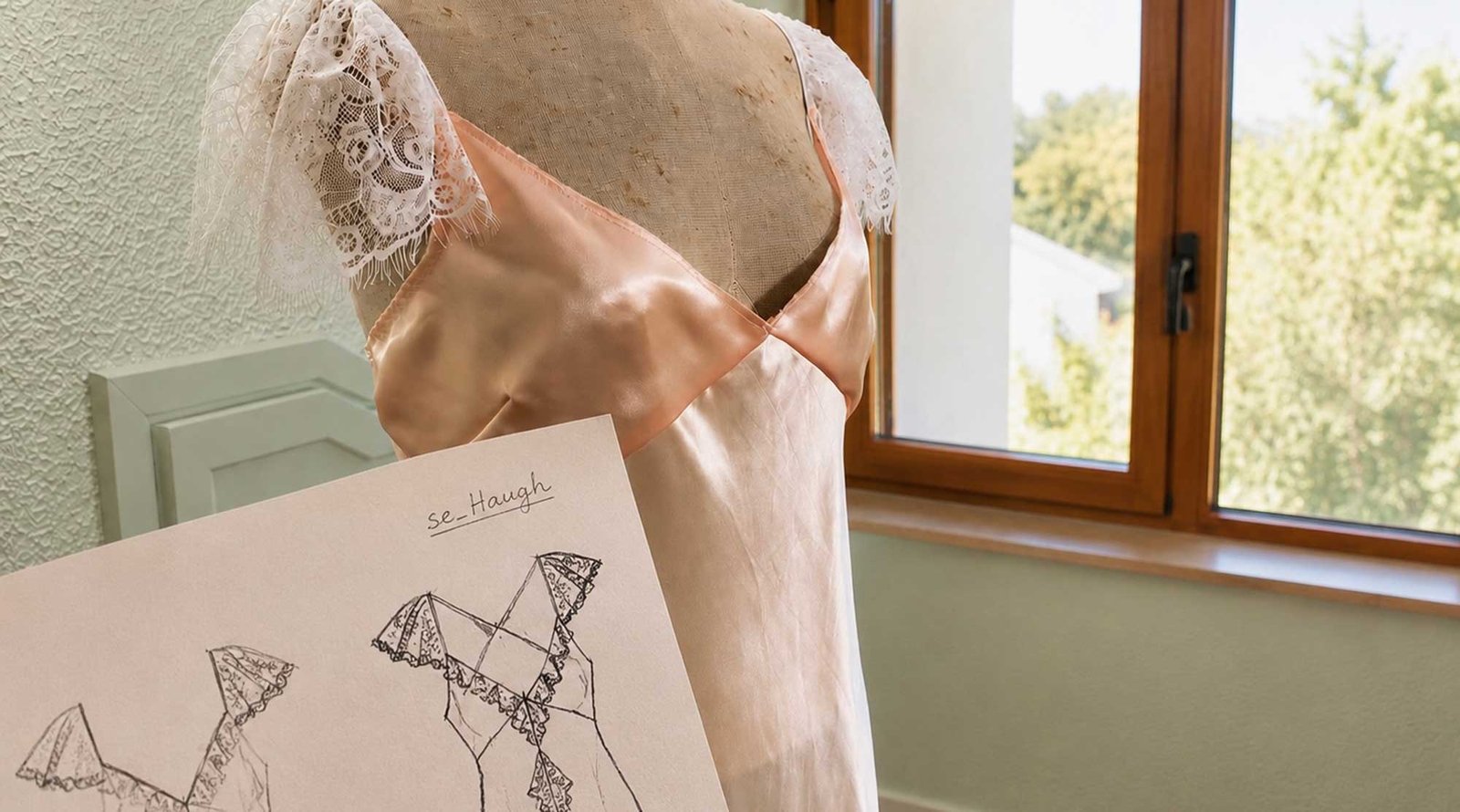
The nightgown, for example, had already been designed in the past, but only for women. Adapting it for a man meant rethinking the proportions rather than simply changing the measurements. The relationship between the shoulders, the neckline and the chest creates a completely different visual harmony, and that could only be judged once the design existed in three dimensions.
The camisole presented a different challenge. It was an entirely new design, so I needed to verify that the proportions, the placement of the shaping and the overall silhouette worked together as I had imagined while sketching. The shorts also evolved considerably during the design process. Although they were inspired by an existing idea, they were reworked to achieve a different length, a different proportion and a level of ease that would feel comfortable while still preserving the elegance I wanted for the finished ensemble.
Looking back, I realise that these three pieces all required prototypes for different reasons. None of them were about questioning the design itself. Instead, each prototype allowed me to observe how an idea behaved once it left the page and became real. Only then could I decide whether a neckline needed to move slightly, whether a dart should be repositioned or whether the proportions still expressed the idea I had first sketched.
From Sketch to Pattern
Every bespoke garment begins long before the first piece of fabric is cut. Sometimes the process starts with a conversation, sometimes with a sketch, and more often than not with both at the same time. As I exchange ideas with my client, the design gradually begins to take shape on paper. By the time I start drafting the pattern, many of the creative decisions have already been made. The construction has been carefully considered, the proportions explored, the placement of the lace defined and many of the finishing details are already part of the design. The sketch doesn’t simply illustrate the garment; it already contains the ideas that will guide every stage of its creation. The pattern, however, has a different role. Rather than replacing the sketch, it becomes the bridge between that original idea and the body it is being created for.
People often think of pattern making as the technical stage of garment creation, and of course it requires precision, accuracy and a thorough understanding of how fabrics behave. Yet I have never experienced it as something separate from the creative process. For me, pattern making is simply another way of drawing. The difference is that, instead of drawing on paper, I am now drawing directly onto the body. Every seam, every dart and every curve becomes another creative decision. They do much more than connect pieces of fabric or shape a silhouette. They guide the eye, influence proportions and determine how the original design will eventually be perceived once it is worn. Moving a line by only a few millimetres may seem insignificant while working on a pattern, yet it can completely change the harmony of the finished piece.
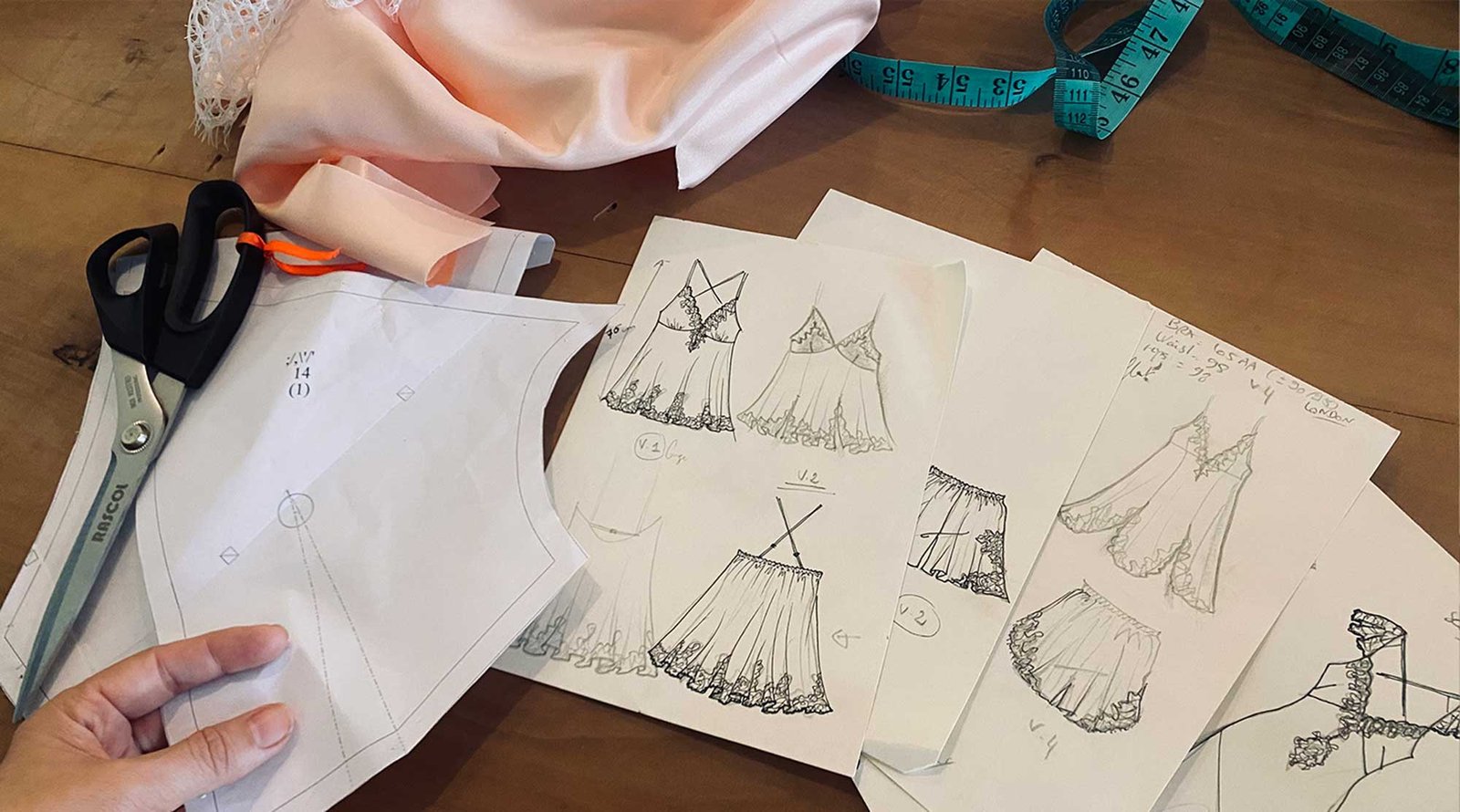
This is also where bespoke pattern making becomes so different from working with standard sizing. My sketches are usually created using standard proportions because their purpose is to communicate the design itself. A bespoke garment, however, is never created for a standard body. Every client has their own proportions, posture and way of wearing a garment. As I develop the pattern, I constantly rethink the relationships between those lines so that the original design remains visually balanced once it is adapted to one particular person. Sometimes that means moving a dart slightly higher, adjusting the position of a princess seam or subtly reshaping a neckline. Those changes are not there to alter the design. Quite the opposite: they allow the original idea to remain faithful to itself while adapting naturally to a completely different body.
By the time the pattern is finished, many of the important creative decisions have already been made. Even so, some questions simply cannot be answered on paper. I can see the proportions, understand the construction and imagine how the piece should look, but I still cannot observe how it will move, how the fabric will drape or how all those carefully considered lines will interact once they exist in three dimensions. At that point, imagination reaches its limit, and observation becomes far more valuable.
That is where the prototype begins.
When the Garment Becomes Three-Dimensional
There is a moment in every bespoke project when the design finally leaves the paper. Until then, I have been working with sketches, measurements and patterns, imagining how every line will come together once it exists in fabric. Seeing the prototype assembled for the first time changes everything. What had previously existed only in two dimensions suddenly has volume, movement and presence. Some aspects immediately feel exactly as I had imagined, while others reveal straight away that they still need to evolve. Those first observations are not about deciding whether something is right or wrong. They are about discovering how the original idea behaves now that it exists in three dimensions.
I usually begin by walking around the mannequin several times before making any changes. Looking at a design from different angles often reveals relationships between the lines that cannot be seen from the front alone. Sometimes I immediately recognise what needs to change. A neckline may feel slightly too open, a seam may interrupt the harmony of the silhouette or a particular proportion may simply not create the visual effect I had imagined while drawing it. Other times, nothing obvious stands out at first. I simply have the feeling that the piece isn’t yet expressing the idea as clearly as it should. That is enough to tell me that I need to keep exploring before making any decisions.
My first experiments are often done with pins because they allow me to test an idea quickly. Raising a neckline, moving a strap or subtly changing the direction of a seam immediately shows me how those adjustments influence the overall silhouette. Very often, those first changes confirm the direction I want to take. They help me understand what the piece needs. But they are only the beginning. Pins can suggest a solution; they cannot replace the construction itself.
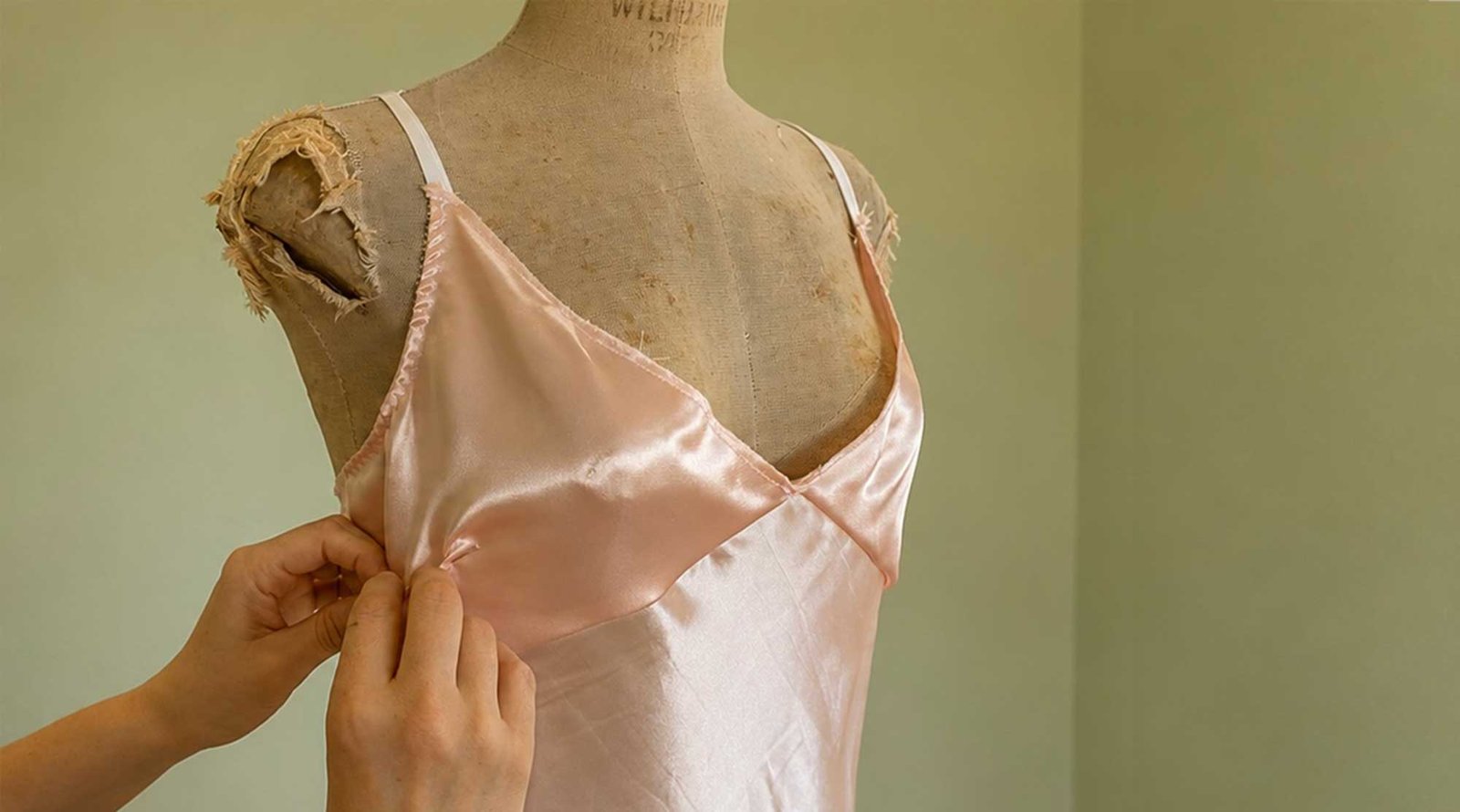
The nightgown from this commission illustrates that process particularly well. I began by pinning different neckline positions until I understood where the balance should be. Very quickly, however, I realised that I had reached the limit of what pins could tell me. The changes I wanted to evaluate affected the construction itself, so the bust section had to be completely taken apart. I recut the pattern pieces, rebuilt the upper section and carried out another fitting. That second fitting answered the first question, but immediately revealed another. Because the nightgown is cut on the bias, the lower section didn’t have quite enough fullness to create the movement I was looking for. That area therefore had to be recut before I could evaluate the design again.
Only after making those changes did I realise that the neckline still wasn’t expressing the balance I had originally imagined. At that stage, there was no point trying to solve the problem with a few more pins. The upper section had to be dismantled once again, reconstructed and fitted for a third time before I finally felt that the design was expressing the original idea I had sketched. Looking back, each fitting answered one question while revealing the next. Rather than seeing that as starting over, I see it as the design gradually becoming clearer. Every stage brings the piece a little closer to what it was always intended to become.
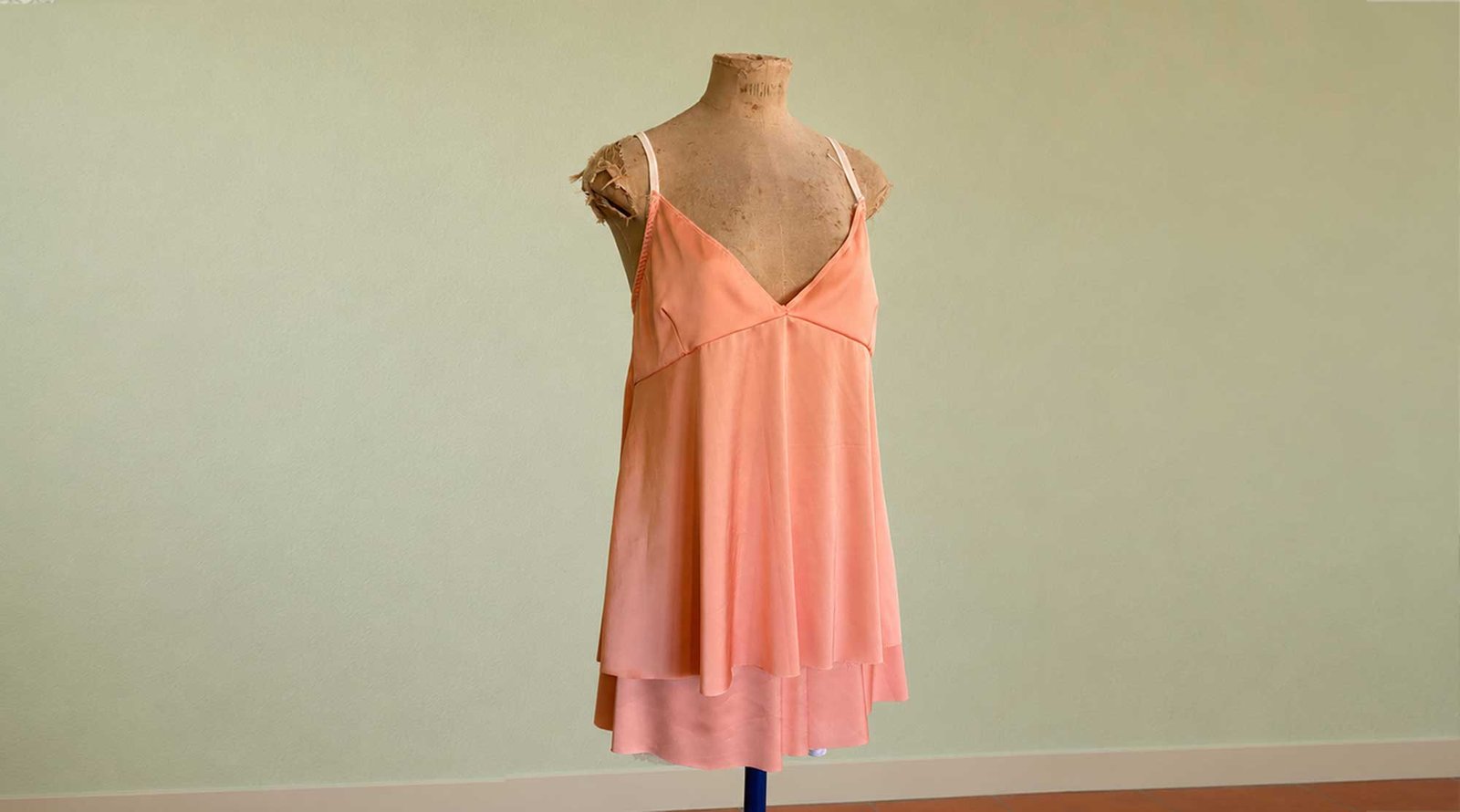
The three garments in this commission each followed a different path. The camisole came together almost exactly as I had imagined and will only require very minor adjustments before being sent to my client. The shorts needed a small correction that I preferred to make before the fitting, allowing my client to see a prototype that already reflects the direction I believe the design should take. The nightgown, on the other hand, demanded several rounds of reconstruction before it reached that stage. Every design follows its own rhythm, requiring a different sequence of decisions before it is ready for the next step.
Although the mannequin plays an important role throughout this process, it is never the final destination. My mannequin represents standard proportions, while bespoke garments are created for one particular person. Whenever it is helpful, I also ask someone close to me whose proportions are similar to my client’s to try on the prototype. Seeing the design on a living body often reveals details that neither the mannequin nor the pattern can show. Movement, posture and the way the fabric responds all become part of the fitting process. My client’s fitting then becomes the final stage before I begin working with the silk, allowing us to refine the last details together before the finished garment is created.
Before the Silk Is Cut
By the time a prototype reaches my client, it has already gone through several rounds of observation, adjustments and reconstruction. Some pieces arrive at that stage very quickly, while others take longer to find their final balance. That difference is perfectly normal. Every bespoke design follows its own path, and every prototype has fulfilled the purpose it was created for before the final garment can begin.
One common misconception is that prototypes are always made from plain cotton. Sometimes they are, but not always. The choice of fabric depends entirely on what I need to evaluate. If I am primarily checking the construction, proportions or overall harmony of a design, a traditional toile is often all I need. However, when the way a fabric drapes is an essential part of the design, I prefer using a material that behaves much more like the final silk. Although it isn’t the precious fabric itself, it allows me to judge movement, volume and the relationship between different elements much more accurately. A prototype is never intended to imitate the finished piece perfectly; its purpose is simply to answer the questions that still remain before the silk is cut.
Once I feel that the prototype has reached that stage, it is sent to my client for fitting. This is an essential part of every bespoke commission because, no matter how carefully a design has been developed in the atelier, it has ultimately been created for one particular person. During the fitting, my client can tell me how the piece feels to wear, whether they would prefer a little more ease, a slightly different length or another subtle adjustment that only becomes apparent once it is worn. They also send me photographs wearing the prototype, allowing me to observe it on the body it was designed for and identify details that would be impossible to judge from measurements alone.
By this stage, the conversation is no longer about changing the design itself. The sketch has already defined the idea, the pattern has adapted that idea to my client’s proportions, and the prototype has allowed it to evolve in three dimensions. The fitting is about refining those final details that transform a well-made piece into one that feels truly personal. Very often, the adjustments are subtle, yet they make all the difference because they respond not only to measurements but also to the way each individual prefers a garment to fit, move and feel.
Only after those final decisions have been made do I unfold the silk.
For me, that moment has never been the beginning of a bespoke garment. In many ways, it is the conclusion of everything that came before it. By then, the design has already lived through conversations, sketches, pattern making, prototypes and fittings. Countless small decisions have gradually shaped the piece until it has become exactly what it was intended to be. Cutting into the silk is therefore not a leap of faith. It is the moment when every previous stage comes together, allowing me to focus entirely on creating the final garment with the care, precision and craftsmanship that bespoke deserves.
Every bespoke project begins with a conversation. If you are considering creating a piece designed especially for you, you can learn more about my bespoke process below.



Add comment
You must be logged in to post a comment.